Kick in the Jaw by Dan Albergotti
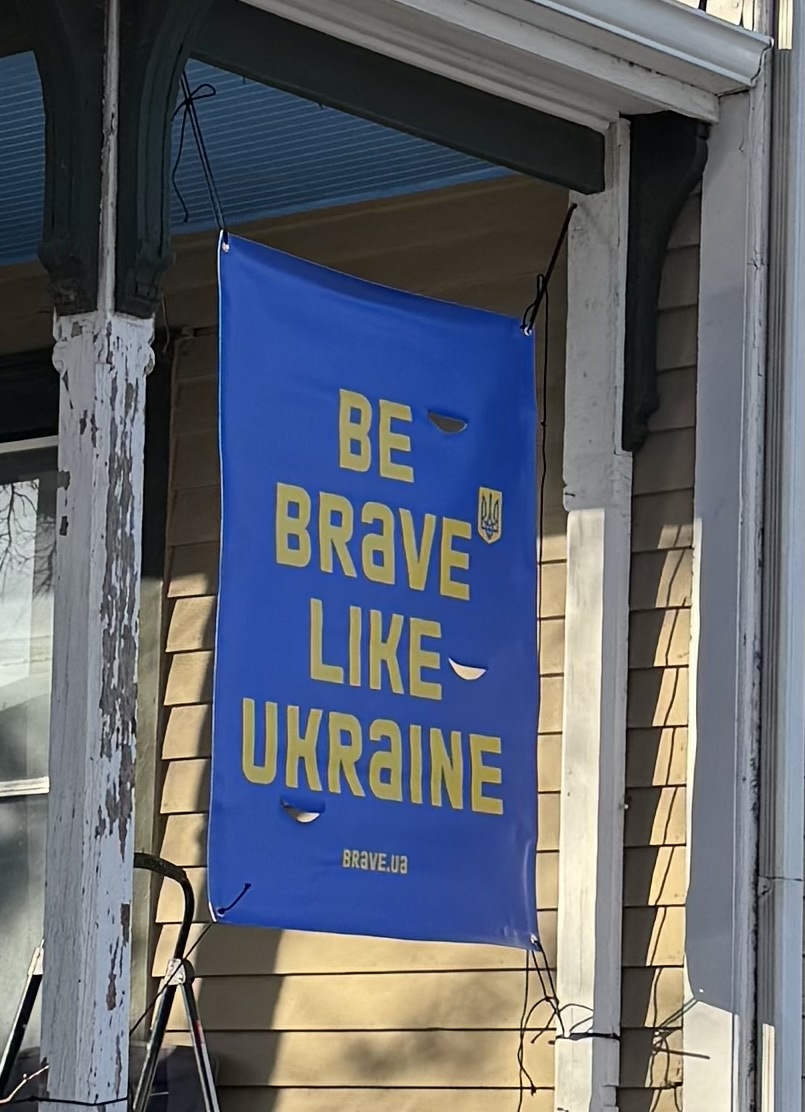
Not long after Russia invaded Ukraine, my wife Amy had a sign made that hangs outside our house. It’s blue with yellow capitalized sans serif letters and it says “Be Brave Like Ukraine.” She had it made to show support for the Ukrainians but the message isn’t for them. It’s for us.
Bravery is complicated for me. I grew up during the Cold War. When I was in second grade, a new kid in a new school in a new state, far from everywhere I’d known and all my extended family, a substitute teacher informed the class that in the event of a nuclear war, New Orleans (where at least one parent of pretty much everyone in the class and both of mine worked) would be one of the Soviet Union’s top five targets because of its importance as a shipping port. And then we practiced getting under our desks in case the siren went off, because they would protect us from fallout and radiation I guess.
If I had to guess, I’d say that substitute teacher thought he was doing us all a favor, getting us ready for the harsh realities of the real world. Or maybe he figured that if he had to walk us through an exercise in futility we should at least know why we were doing it. I don’t remember him telling us to be brave, but also we were practicing for a danger that even now feels different from the daily violence of our lives.
Violence for me back then was schoolyard bullies and corporal punishment both at home and school. It was slapstick humor and wild west shootouts and athletes breaking their bodies against each other on live tv. It was “swing on your bully and he’ll back down” and “let them fight it out.” Bravery was measured in your willingness to risk getting your ass beat in public.
The stories I read and saw at that age fit a couple of basic molds when it came to violence. Mostly it was authority using violence to stop bad things from happening to those it claimed to protect, and when it involved rebellion against that authority, the ones in charge were caricatures of oppression and/or corruption.
Sports also normalized violence, whether it was boxers trying to take each other’s heads off or professional wrestlers playing face and heel in sweaty soap operas, pitchers “sending a message” with a fastball to the ribs and batters charging the mound after being knocked down. It was football players with nicknames like Assassin and Hacksaw who were famous for the damage they did to opposing players.
It even extended to the natural world. I can’t say I went out of my way to watch Mutual of Omaha’s Wild Kingdom regularly but my impression of the show is that at least once per episode, some big cat was chasing down a deer. It always felt noble, the graceful cheetah exploding with speed after a gazelle and no matter how many times the gazelle changed directions, finally the cheetah would get hold of it and it was over.
Sometimes they were contrasted with hyenas or jackals, who hunted in packs and picked off the weak or sickly members of the herd. They were sneakier, and even worse, they were carrion eaters, picking at the remains of what other stronger and more beautiful predators had left behind.
Sometimes the prey escaped. They were too fast; the predator had alerted them to its presence early or had underestimated how long it would take to tire them out. But there was always the feeling like the gazelle was delaying the inevitable.
I’ve never identified with the predatory part of the world, though no doubt some people would see me as connected to it. That’s a level of complication I’m not trying to get into at the moment. I’m saying that if there’s a lion and a gazelle, I’m probably going to feel I have more in common with the gazelle, mostly interested in avoiding confrontation when possible. I haven’t swung on another person since I was in junior high school, and even when I was a bartender in college, I focused on separating people who were fighting. I’d be quite content with never striking another human being in anger for the rest of my life.
Some people hear that and connect it to cowardice and more importantly, to an unwillingness to fight or defend themselves should the need arise. We’ve seen that recently with the confused responses by many in our government and on the political right to the organic resistance that’s sprung up in multiple cities to the kidnapping of our neighbors by government agents. They were surprised to see regular people be brave and say no and put their bodies between their neighbors and the outsiders who had come to take them away. They thought of themselves as the lions and the locals as zebras who would run away the minute fangs were bared. They were wrong.
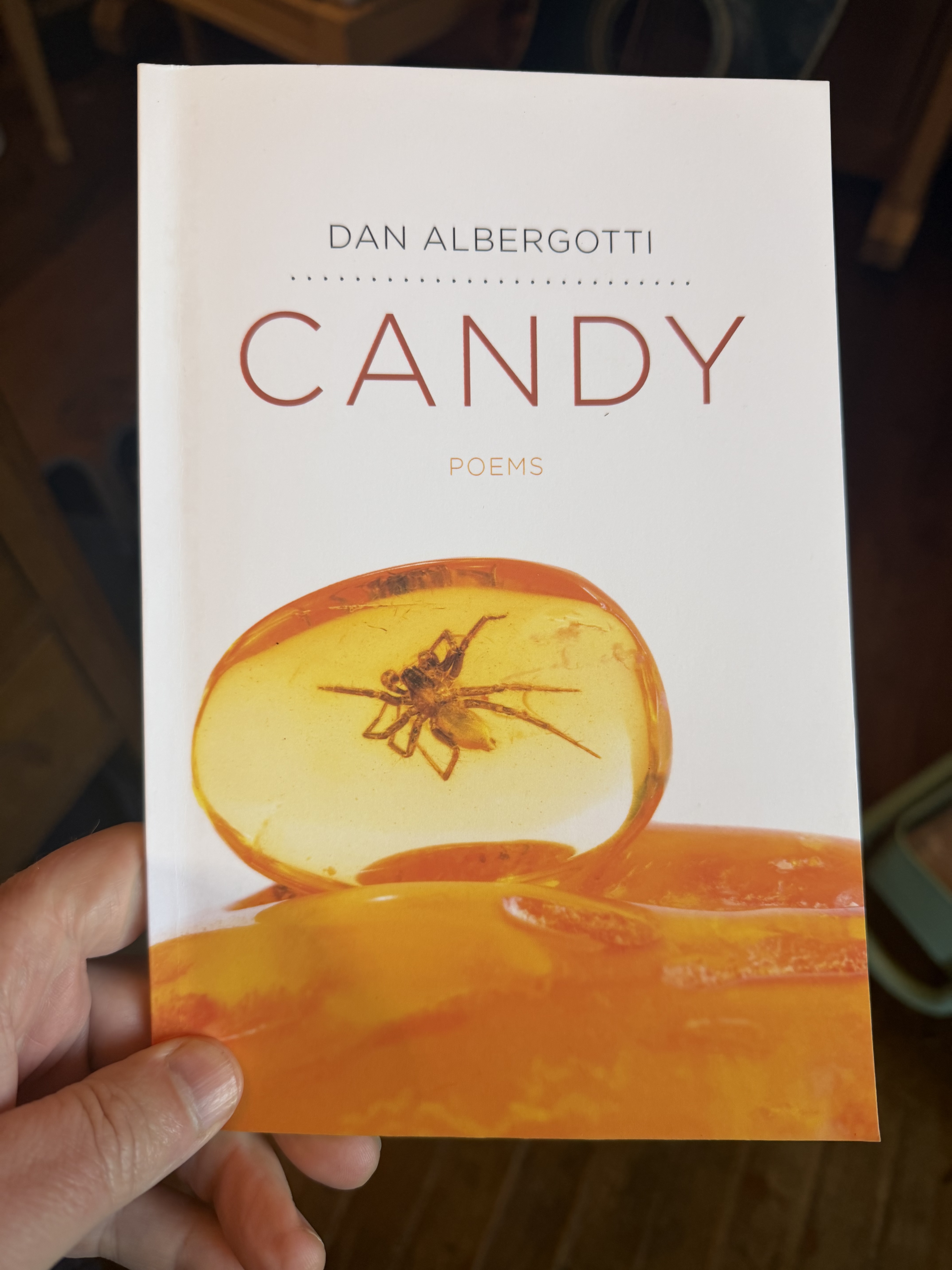
The opening poem of Dan Albergotti’s collection Candy (LSU Press 2024) is what got me thinking of our current moment in these terms. The title is “Kick in the Jaw” and it opens with the line “Sometimes the zebra wins.” That’s kind of a jarring line if you don’t know much about zebras. It’s a common mistake to think they’re similar to horses in temperament because they’re part of the same family, but no zebra has ever been domesticated. They’re too aggressive. But even if you know that about zebras, it’s still an interesting contrast to Albergotti’s next lines. Here are the first four together.
Sometimes the zebra wins. And the sound
of the savanna goes on—birdsong, frog croak,
beetle chitter, snort and grunt of a warthog
hard panting of the cheetah after chase—
Sometimes the zebra wins and nothing is different. It’s as much a part of the natural world as the predator winning. Even the cheetah in this scene isn’t feeding. It’s panting, gathering its energy for the next attempt. But if the zebra just managed to dodge the cheetah for now, that doesn’t seem like much of a win. The poem continues:
as the lion walks slowly away, bleeding from
the mouth, staring ahead, looking for a place
to rest and await a slow starvation. Sometimes
the savanna’s ambient song is interrupted
by a sharp crack that sounds like a gunshot,
the zebra’s kick finding the lion’s jaw.
I’d be anthropomorphizing to say that the zebra is brave here. This is just nature, cruel and violent. The zebra kicks because it can and it connected with the lion and more often than not, the lion is probably going to win this encounter and it doesn’t mean anything larger than that. Albergotti says as much in the final lines:
Some stories get rewritten. Sometimes
the lion dies. Always the sound goes on.
It’s the first two sentences there that really grabbed me, and it’s why this poem has stuck with me and why I decided to write about it. “Some stories get rewritten. Sometimes the lion dies.” Just because you’re not a predator that doesn’t mean you’re destined to lose no matter how much the predator wins in the stories. Sometimes the zebra breaks the lion’s jaw.
Notice that the world doesn’t end when the lion’s jaw is broken. It will end for that lion, but there are other lions. It will eventually end for that zebra, but there are other zebras.
I’d bet that Dan didn’t have any particular political or war-type situation in mind when he wrote this poem. I’m stretching this metaphor pretty tautly, mostly because I need to remind myself that no situation is hopeless, that there’s always a sound in the background continuing, and that I can find a way to be brave if I remember that.
Thanks for reading Another Poem to Love. Feel free to share this with anyone you think would appreciate it.

 Another Poem to Love