I started trying to publish poems just before the internet exploded into life. This was the late 90’s and I was a nontraditional student English major Creative Writing minor just getting my feet wet. At some point I remember going to a bookstore and buying the Writer’s Guide, this massive book full of submission guidelines for magazines and journals. I pored over the entries, looking for places that I thought would be open to beginners. I spent money on stamps and envelopes and ink cartridges for my printer and started keeping a list in a notebook of which poems I’d sent where and later, what kind of response I’d gotten, if any, along with the rejection.
Payment was almost always in contributor’s copies, thought funnily enough I never received a copy of the journal I was first published in. It was in the Fall 1999 issue of The Small Pond Magazine of Literature and it was titled “This is a poem that will never be published.” Digging around a little online I found three issues from 1990 available at the Internet Archive and saw that the magazine’s archives are available at Yale University, which makes me feel kind of good I suppose. I can’t say it’s a poem I’m especially proud of anymore, but it was the first time an editor looked at something I wrote and said “yeah, I want that.” There’s no substitute for that feeling, I think.
I was late to the internet journal explosion. Some of my MFA classmates at the University of Arkansas started an online journal before I graduated but I didn’t pay it much attention, which was pretty short-sighted of me I think. Naive, no, ignorant, really. I wanted to believe that publishing was a competition, and a fair one, that your name and credentials didn’t matter so long as your poems were good enough, whatever that meant. I hadn’t spent any time thinking about the breadth of styles and types of poetry that existed out there and I was frankly pretty dismissive of a lot of stuff I didn’t like or get. I also didn’t get the idea of literary community yet.
I remember having conversations with other writers in the early 2000’s about publishing online and even when there was some interest in the possibilities, there was still this sense that print was the place to be if you were going to be “taken seriously” as a writer, and I think that position made sense if you were thinking about publishing as part of the pathway to getting a tenure-track job. Online publications didn’t count as much as print did, if they counted at all, because the overwhelming sense was that online publishers didn’t have to be picky. They could publish anyone or anything because the price of entry was so much lower than putting something into print was.
It didn’t help that the biggest places for poetry online in the early days were basically vanity presses that would publish anything you submitted and would occasionally award “prizes” where you could buy a print-on-demand copy of the latest anthology of their prize winners for an exorbitant price.
Over time, writers discovered that many of the people who were starting online journals and selecting poems for them weren’t just half-assing it, that in many cases they felt an urgency to prove that the work they were selecting was better than what was appearing in print journals. (Better and worse are not terms I tend to use when talking about poems. I think more about who poems speak to, who they’re meant for, what they’re trying to do and how well I feel they accomplish that.)
What also happened was that the economy crashed again and again and universities, which tended to be the primary funders of a lot of the print magazines, felt that the meager funds going to those journals could be used elsewhere. Some print journals went online. Others folded.
I was a part of this world i my position as Poetry Editor of The Rumpus, I job I took in 2009 and kept in some form until 2024. We started out doing book reviews of poetry collections, then publishing original poems during April for National Poetry Month, then eventually making them a regular feature many years later. It’s kind of remarkable that the magazine has kept going for now 17 years because so many journals haven’t.
Online journals go under for any number of reasons but in my experience the big one is that the editors get burned out. It’s a lot of work to run a magazine, and if you have a job or a family or both and something has to give, it’s often the first thing to go. I was out of the day-to-day editing well before LLMs appeared and really made things chaotic. It’s got to be an absolute shit-show now, especially if you’re a new writer just trying to get published.
Because I can imagine being an editor trying to sift through a deluge of submissions with deadlines and other calls for your attention not to mention your own desire to create and saying subconsciously “oh, I recognize that name, I’ll look at their stuff first.” To be clear, I don’t specifically know of anyone doing this. It just seems logical to me that it happens.
When I oversaw the National Poetry Month poem-a-day project for The Rumpus, I started by soliciting poems from writers I had met either in person or online. Not because I wanted names but because I knew I didn’t have the time to handle a flood of submissions, and also because I deliberately wanted a variety of styles and writers. I didn’t trust my subconscious to select poems blindly. I also occasionally solicited poems from people whose books we were reading in the Rumpus Poetry Book Club. And then I started asking people I’d published before for recommendations, for their students or friends who maybe were just starting to publish. And in so many cases, these were writers who I probably would never have read on my own, but my experience is so much richer for it.
Very recently I’ve been boxing up books and most everything else I own because we’re on our way to Romania for the next nine months, and that includes all the print journals Amy and I have appeared in over the last twenty-plus years. I thought about all this because I was reading an advance copy of Pagan Sky New and Selected Poems 2000-2025 by Michael Waters which comes out from BOA Editions in October. I’m not really familiar with Waters’ writing which is something younger me would find surprising but current me doesn’t because I have a better sense of just how massive the writing world is. It’s easy to read widely and yet never hear of someone who’s been publishing a long time.
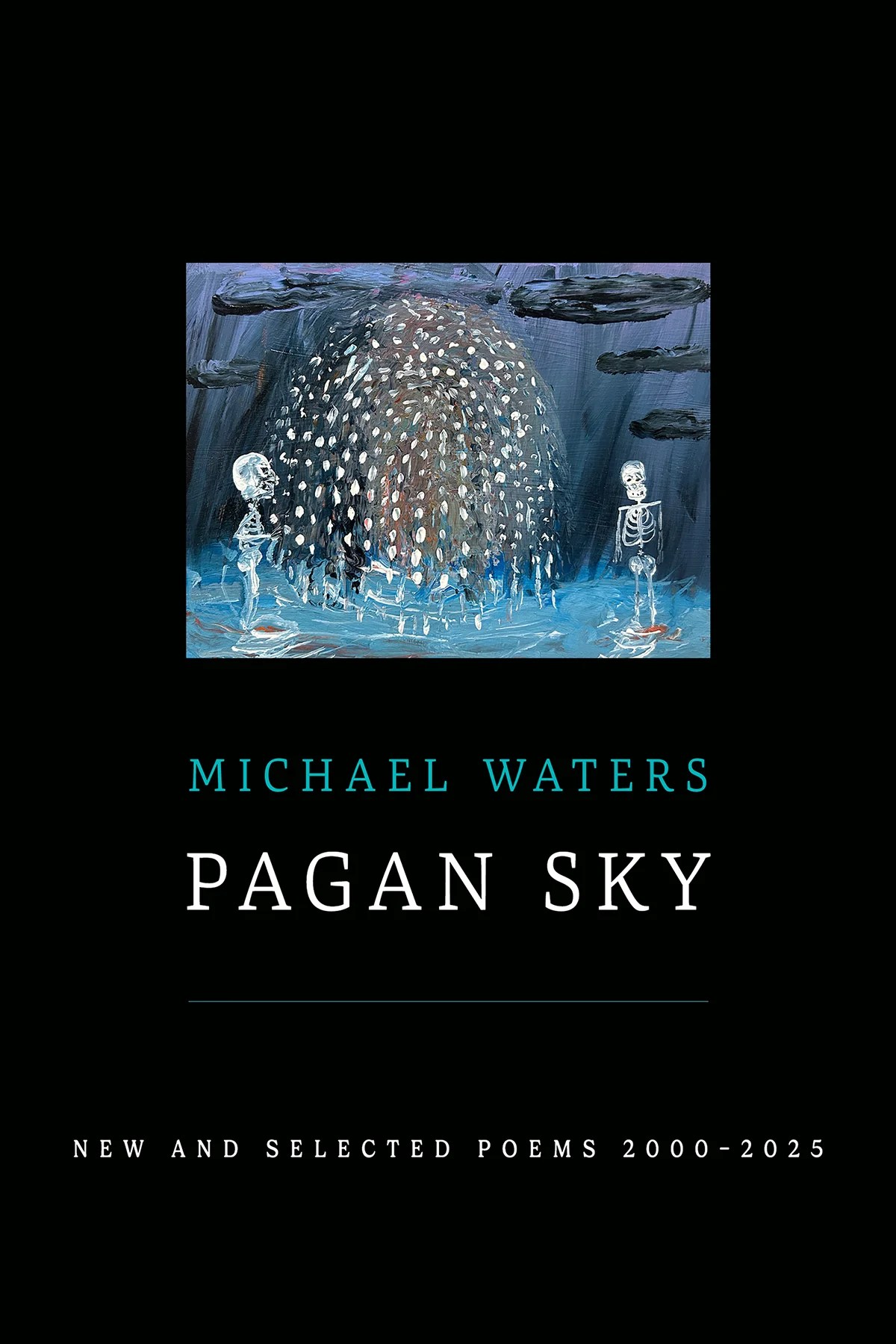
Anyway, the poem that sparked this piece is called “Nobody’s Poem” which first appeared in the fall 2018 print issue of Solstice Magazine. I think it’s fair to say that this poem strays some from the subjects of most of the other poems in this collection, though the voice and tone are consistent. I only say this because if, like me, you’re not familiar with Waters’ poems, I wouldn’t want you to be surprised if you get this or another of his books and are confused by what you read.
Okay, so one of my confessions is that I often like poems that play with the stereotype of the poet, which is where this poem begins for me.
In the solitude of this cottage room
Where the only sound is the on-again
Sotto voce whisper of the furnace
And the pipes’ insistent knocking
As if the unwanted babe of the Muse,
mewling creature swaddled in newspaper,
Has been dumped one more on the doorstep
To be clear, there’s no end punctuation in that quote because we haven’t gotten to the end of the opening sentence yet. The period won’t show up for another line and a half which is also where there’s a hard break in the poem, with the start of the new sentence dropped down to create white space above and behind it.
But look at the images in that section. We have a cottage, quiet save for the knocking of the pipes which suggests it’s old and probably somewhat isolated. There’s the use of the Italian “sotto voce” and not just an invocation of the Muse, but the mewling, unwanted babe of the Muse. That part actually cracked me up because of how over the top it is. The only thing missing is a beret.
But here’s the end of that sentence that started in line one. “The floor-to-ceiling bookcase hoarding one wall / Filled with forty-year-old literary journals / Holds its breath.” The subject of the sentence, the bookcase, shows up in line 8 and the corresponding action, “holds its breath” finally appears in line 10, right before that hard break I mentioned earlier. This poem is working hard to be Poetic.
The second half of the poem is two sentences and the I of the poem appears early. They’re standing in front of this wall-length bookcase, and it must be a hell of a wall to hold all these journals.
If I move, if the air stirs,
The dust spouts again the words of poets
Listed in ten thousand Tables of Contents.
That’s a lot of contributor’s copies and a lot of poems published and a lot of dust. I’ll only speak for myself here but I suspect most of them don’t get read much after they get put on the shelf. I’ve had the experience of pulling one down to check something and then realize, when looking at the table of contents, that I’d been published alongside someone I met later in life.
But here’s where the poem turns, and in a way, I think it hits at the darker side of how some poets look at ourselves and others.
Even the journal in which this poem appears
Will be wedged in a wall among its brethren
Until someone down the decades draws it down
To drag one finger down the list of contributors:
Nobody, nobody, nobody, name, nobody, nobody
All the way down to the cold damp ground.
I take it back; it’s not about how poets look at ourselves and others. It’s about how we fear we’ll be viewed once we’re gone. It reminds me in a way of a poem by Miller Williams from The Ways We Touch titled “A Note to the English Poets of the Seventeeth Century” which talks to critics and scholars who decide who gets to be anthologized and by extension, remembered by future readers, and acknowledges in the end that it’s really himself he’s talking about.
What I find most interesting about the way Waters hits this note is the coldness of both nobody and name, the complete erasure of any humanity there. The person down the decades isn’t opening the book to discover something new or beautiful or challenging. They’re reducing the work to whether the name of the contributor is one that lasted for whatever reason. There’s no indication that the person is excited about the name they recognize. That they recognize the name seems to be the point, even while their finger drags down the page toward the grave.
Thanks as always for reading. If you like this series, I hope you’ll share this post with someone you think will appreciate it.


