Adultery by James Dickey
As you may have read, I’m doing a project at Patreon titled “Eating Popeyes in Romania” which is about our family’s ongoing experiences in Iași while Amy is a Fulbright Scholar. Amy just posted a piece about our epic journey to get here on her Substack and you should all go read it (along with everything else she writes because, no bias here, she’s effing brilliant). I’m posting this piece in both places because it’s both about poetry and Popeyes. I hope you like it.
I can’t remember the first time I wrote a parody of or response to a well-known poem. If I had to guess, I’d say it was probably high school because that’s when I started writing intentionally and parody is a good way to learn how to play with the restrictions that form imposes on your work. You’re fitting your thoughts into the mold another poet used with the knowledge that your poem, should anyone else read it, will possibly be compared to the original, for better or worse.
Sometimes what I’ve done is copy the rhythm and played off the opening lines before going in my own direction. There’s a poem in my first book which starts “i sing of brian // born of god” which uses the same rhythms as E. E. Cummings’s “i sing of olaf” but instead of being about a man who was drafted into the military who refuses to submit to the state’s desire to turn him into a killer, mine is about leaving the faith I was raised in.
Sometimes I’ve gone more absurd, like the time I parodied one of John Donne’s Holy Sonnets, the one that starts “Batter my heart, three-person’d God, for you” by turning it into “Batter my arteries.” I hadn’t thought about it this way until just now but I guess my connection to deep-fried food in my writing has been there for a while. In that case, I also followed the same rhythmic and rhyming structure as Donne. It was as close a parody as I’ve ever done.
But in other cases, I’ve taken another person’s poem and then decided to reimagine what I see as the central move in a different context. That’s what’s at the heart of the long Reclamation poem I’ve been posting about over the last couple of years, trying to recast Robert Frost’s “The Gift Outright” in more personal terms, pulling it away from his very narrow conception of the US as a place that British colonists “gifted” themselves and thinking of it more as a relationship between individuals and both the places and the people they’re connected to.
I did a bit of both a few years ago with the poem I’m talking about here, James Dickey’s “Adultery.” The difference here is that while I’m somewhere between ambivalent and annoyed by Frost’s poem—I love the rhythm and sound of his poem but just shake my head at how myopic the speaker is—I genuinely love Dickey’s poem, despite the feelings I have for the speaker.
Dickey makes two big choices in the title and the first line. As titles go, “Adultery” is anything but subtle, regardless of where you feel it lands in the pantheon of sins. It’s jarring because it’s unexpected as the subject of a poem, especially if you’re not a wide reader. When I’ve taught this poem in the past, students have occasionally asked why write about this. They’re used to less messy love poems, or at least they think those other poems are less messy, but that’s another conversation.
The second big choice Dickey makes is to implicate the reader in the first lines. “We have all been in rooms / We cannot die in, and they are odd places, and sad.” My first thought when reading those lines, even now, is no we haven’t all been in those rooms. It’s the way he’s so casual about assuming that which carries the force for me, the way he reduces this sin of betrayal to something everyone has done, how he’s so matter-of-fact about it before going into this description of the bland, unchallenging cheap hotel room art that’s there mostly to fill space on the walls.
But it’s in that description where we first get to see some sense of guilt, which is the emotion that will drive the rest of this poem. Sandwiched between images of Indians on hills in the sunrise and men driving the gold spike which connected the first intercontinental railroad are cattle “browsing on the walls / Far away gazing fown with the eyes of our children / Not far away.” It’s the one-two punch of “our children”—implicating the reader again and emphasizing the betrayal—combined with the line break before “not far away” which in that moment I read as a sign that this isn’t happening far from the speaker’s home (later in the poem the speaker sounds like he travels regularly for work, so I’m less sure). Maybe it’s “not far away” in memory, that the eyes force him to reckon with what he’s doing in that moment.
Dickey uses “we/us” throughout this poem but it starts to narrow in the next stanza to just the two people in this room. “There is always some weeping / Between us and someone is always checking // A wrist watch by the bed to see how much / Longer we have left” and it’s followed by one of the least sexy descriptions of infidelity I’ve ever read:
Nothing can come
Of this nothing can come
Of us: of me with my grim techniques
Or you who have sealed your womb
With a ring of convulsive rubber:
Although we come together,
Nothing will come of us.
It’s interesting how the speaker moves from nothing can come of this, this recognition that both the speaker and the partner are locked in their current relationships, to nothing will come of this, a reference to birth control and the idea that the lover getting pregnant just can’t be allowed to happen, and it leads into this moment where the speaker acknowledges that what’s driving this affair is the fear of death. The poem starts with this idea that the speaker can’t die in this type of room because then everyone would know what he was doing there and it would negatively affect how survivors would perceive him but nearer the end he’s suggesting that it’s this act that is keeping both of them alive.
But we would not give
It up, for death is beaten
By praying Indians by distant cows historical
Hammers by hazardous meetings that bridge
A continent. One could never die here
Never die never die
While crying.
There’s this flurry of self-justification that Dickey emphasizes by removing any punctuation that would slow the claims down to where they could be challenged. Also notice the shift from the start of the poem where the speaker talks of “rooms we cannot die in” because of the consequences versus “one could never die here” because this is the one place the speaker feels alive.
Before I dig into the end of this poem, I want to talk some about the parody/response I wrote to it a few years ago, if you’ll indulge me.
My poem is titled “Guilt is Magical,” which is the last sentence in Dickey’s poem, and as I hinted at earlier in this piece, it’s about food and my sometimes unhealthy relationship with it. I’m going to post the whole thing here.
Guilt is Magical
–after James Dickey
There’s a road I cannot die on,
won’t even chance a quick left
across traffic for fear
a wreck will wreck me.
I’m only ever there for
a three-piece spicy with dirty rice
eaten alone, hunched over
the table with one eye on the time
which is dumb because no one
who loves me cares if I’m there.
No need to sneak. I tell myself
I’m sparing them, that I
don’t want to force them into
food they don’t enjoy, food
that takes me back to childhood,
to the Popeye’s in the A&P parking lot,
splitting dinners with Mom and Dad
and sister on a Tuesday night right
before we head to the Kingdom Hall
where we learned God’s fate for sinners
was not a fiery hell, but separation
from His love, much like that one time
I took the mild rather than wait.
Literally this poem is about going to the Popeye’s near the Merle Hay Mall in Des Moines, a store that’s not there anymore because the franchise owner apparently didn’t pay either his franchise fees or his sales taxes and multiple groups were upset about that and took measures.
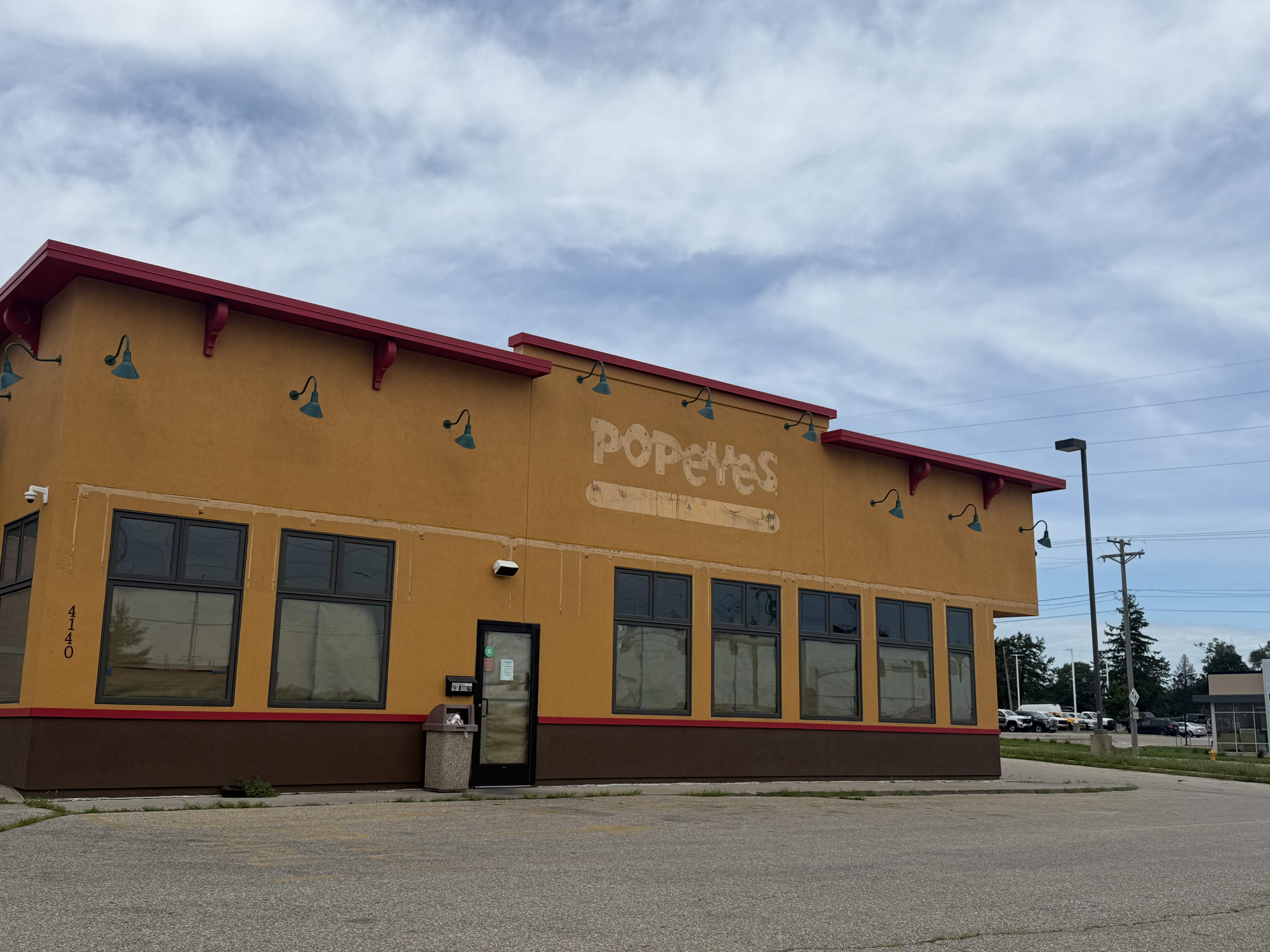
That was a sad day.
Beyond imitating the opening line of Dickey’s poem, what I was really going for is this idea that if something were to happen to me or to our car while I was in that part of town, Amy would know what I’d been doing there because while Merle Hay isn’t particularly out of the way (nothing in Des Moines is far, not by the standards either of us grew up with), there’s also nothing we regularly do there. It’s not the location of any of the places we regularly shop at, for example, and it’s not as close to the interstate as other places.
And as I say later in the poem, it’s not like Amy would have cared that I had gone to Popeyes to eat. The guilt, even the idea that I’m cheating somehow exists only in my head. I’m not even getting the combination of pain and thrill that Dickey’s speaker and his lover go through as his poem comes to an end.
My lover, my dear one
I will see you next week
When I’m in town. I will call you
if I can. Please get hold of Please don’t
Oh God, Please don’t any more I can’t bear… Listen
We have done it again we are
Still living. Sit up and smile,
God bless you. Guilt is magical.
I never know quite what to do with this ending. Is Dickey’s speaker consoling his lover because he’s concerned about her or because he’s afraid that she’s so in love with him that she’ll go public and blow up both their relationships? Who is the last sentence aimed at: his lover or the reader? Or himself? I think the tone of the poem shifts dramatically depending on how you read that. And that’s without examining whether we read magical as positive or negative or indifferent.
In my poem, by making that sentence the poem’s title, I get rid of some of that ambiguity, and my poem is weaker for it. My poem is much more about the internal tug of low-stakes guilt than about something as big as adultery. I think the final image comparing separation from God’s love to settling for mild fried chicken does a decent job through exaggeration of showing how much this guilt is internal and honestly, dumb, but that’s not enough to carry the poem.
For me, the strength of Dickey’s poem is how he manipulates the reader from being implicated in the opening lines to being an onlooker throughout the middle and ending except for that last line, that pronouncement of “guilt is magical.” The end asks me to not just figure out what he means but also examine my own ideas of guilt and betrayal and confront what’s going on inside me.
As always, thanks for reading. I’d love to hear from you in the comments, maybe about your reaction to this poem or the situation in it. And if you’re interested in seeing more about our experiences in Romania, please check out the Patreon page. Supporters in the top tier will receive a postcard in the mail every month from one of the places we’re visiting. There’s still time to get in on the September mailing.


