Translated by Luciana Moroianu
About three weeks ago, I wrote some about our trip from Des Moines to Iași, Romania (by way of Chattanooga, Margate, and airports in Atlanta, Paris, and Bucharest) over on Patreon, which is where I’m writing most of my stuff about Romania. You can sign up here. Most of the posts are free, but if you can support the work I’m doing financially, you’ll get a postcard a month from Romania. Last month’s supporters will receive (soon I hope) postcards from the Palatul Cotroceni, which I wrote about here.
In that first post, I shared some photos of Copou Park, which we briefly lived near when we first got to Iași. It’s lovely and I miss taking the dogs for walks through it. The apartment we eventually settled in is much nicer and larger and there’s also a wonderful green space right outside where I can walk the dogs, so I’m not in mourning or anything, but that park served as a wonderful introduction to Romania for me.
I’m not exaggerating when I say I’ve never been in a place that so openly honors writers. The park with the busts and the benches shaped like books with the writers’ words on them already pushed them to the front of the line, but anywhere I go in Iași, I see streets named after poets and novelists, placards on walls talking about how such-and-such writer used to walk through this alleyway on his or her way to go to the university or to write in a park or go meet with fellow writers for some purpose. (I need to get better at reading Romanian so I’m not forced to use Google Translate for these moments.)
Copou Park is also home to the Mihai Eminescu Museum, a play house, and a small bookstore that’s connected to them. And so, before we moved away from this little park, I made sure to stop in there and look around, and I purchased these volumes.
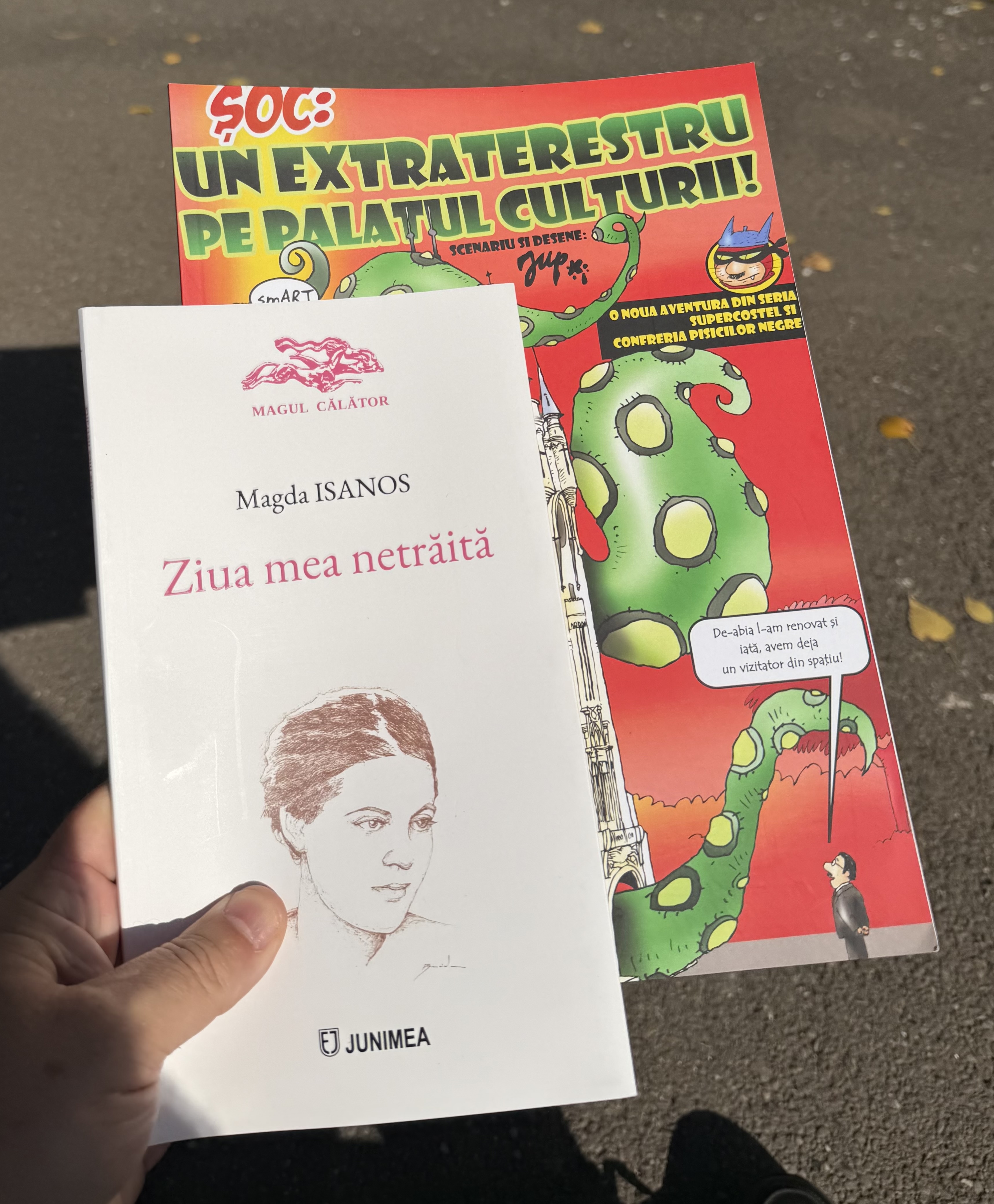
Now to be clear, I didn’t know what I was buying in either case, though I expected that “An Extraterrestrial in the Palace of Culture” would be closer to my reading level. (I was not wrong). I didn’t know anything about Magda Isanos when I picked up her book from the others on the table. I was going with my gut, and with this Google translation of the portion of a poem on the back cover.
How bright you are, my unlived day...
Your halo measures up to my forehead.
I walk through the forest of people and happily
say: "I want to kiss a single star on the mouth..."

My youth shines straight like a sword
And every dream guided by it blossoms.
My lips sometimes said; "I will die"...
But on all seas, I had a ship.
The title of the collection comes from that first line, “My Unlived Day,” and I thought, yeah, if the machine is doing this anything close to justice, then I want to know more about Magda Isanos.
Luckily for me, a Romanian writer named Luciana Moroianu (who I have never met) decided earlier this year to devote a week to telling the story of and translating some poetry of Magda Isanos, and it’s one of those poems I’m highlighting today.
The blurb on the inner sleeve of this collection notes that Isanos, like many Romanian poets, died young, and some of her poems were lost after a bomb struck the courtyard of the house in Iași she shared with her husband, Eusebiu Camilar. She died in November of 1944 from a heart condition related to the polio myelitis she contracted as a child at the age of 28. Moroianu goes much deeper into Isanos’s life and I strongly encourage you to read her posts and follow her work both on Isanos and other poets.
The poem I’m focusing on is titled “Dumnezeu,” or simply, “God,” but the opening lines don’t center the title character.
The rich men made the icons,
gilded altars and pews,
but God never came
in the so confined space.

The rich stood grossly, burdened down
gazing at saints in their beautiful gowns.
Google Translate gave me “fenced-off” and “enclosure” for “îngrădit” in the fourth line, but I prefer the claustrophobic feeling of “confined” when connected to the altars and pews and the images of the saints on the walls. I think of the insides of the Orthodox churches I’ve seen in my short time in Romania—I haven’t been in any of the large cathedrals yet—and how even though the ceilings are tall, the spaces inside them can easily feel tight.
Isanos shows us where God is in the next section, and you wouldn’t be wrong in thinking she’s setting up a contrast between the idea of a God who resides in churches and reinforces hierarchy and a God more focused on the natural world.
Meanwhile, God was flying through the trees,
making them bloom. He ran to the poor,
begging for cornbread and onion.
He was sometimes green field, sometimes water.
Other times he made himself small
and hid in the date-palm flower,
or started to grow in the cornfields,
to help ants in their armies,
to give the earth manna and rain.
Isanos describes a god of nature, one more connected to earth and agriculture, one not obsessed with making sure that everyone around knows how powerful He is. Isanos’s God is willing to make himself small and unobtrusive, able to hide in a date-palm flower, but also doing unglamorous yet necessary work to help even ants.
But this doesn’t mean that He’s not paying attention to what humans are doing, or that He’s unaffected by them.
So many things he had to do,
and people bored him constantly
asking evil upon one another.
He'd hear them shouting: "My land..."
He'd see them placing boundary stones,
chopping up, dividing the wonderful gift.
I’m struck by the word “plictiseau” in the second line there, which the machine gave me as “bothered,” but again I like the image of “bored” better, of God just trying to do his work and but there are these people who are constantly interrupting Him for their tedious needs. For some reason I’m thinking about the scene from the movie Office Space where the main character Peter is interrupted by multiple people asking about his TPS reports, only God seems to like his job.
I think it’s important that the specific sin Isanos is pointing at here is greed. The people are asking God to smite their neighbors (my words, not hers) because they’re trying to take for themselves what should be held in common. I also like how this echoes what Isanos started the poem off with, the idea that God doesn’t want to come to a confined space, whether it’s one dedicated to him or just one where people and animals live.
Here’s the conclusion of the poem.
Then he grew angry. Started the storm.
With drought and frozen rain he kept striking,
making himself great and terrible
as the mountain dressed in forests.
Until a bird came up to him.
A wagtail, or perhaps a dove
and said: "Lord, my chick has fallen down.
Say, pray you, the word and make the weather fair again,
let the sun rise so I may find him..."

"Thy will be done, bird messenger..."
And God put the lightning back in its sheath
and started doing other things.
Again, Asanos does a good job of confounding the reader’s expectations. This is a story we’ve read before, of course. Humans do something that angers God and God (in whatever form) punishes them for it by showing how powerful he is. But in this telling, it’s not the humans who repent for their misdeeds or who beg for God to spare them. The humans aren’t even in the picture here. Instead it’s nature who reaches out, and I don’t think it’s a coincidence that Isanos chooses a dove, not just because it’s a symbol of peace, but because it’s the bird that Noah sends out from the ark which returns with evidence that the land was habitable again.
The other unexpected shift in the story isn’t so much that God listens to the bird, though the “thy will be done” line is a bit loaded, but what happens afterward. God sheathes the lightning and then just goes back to his work.
For me, it’s the way Isanos just pushes humans to the side and mostly casts them as annoyances to God in this poem that attracts me so much to it. God grants the prayers of birds and helps ants with their armies and is bored with humans and their need to own everything.
Isanos doesn’t overdo it either. There’s no point to the poem, no moral to the story. There’s no call to action for the reader. She just has God get back to his work, whatever that is.
Thanks as always for reading. I’d love to hear your thoughts about this poem and your readings of it. I don’t know the next time I’ll be writing about a Romanian poet will be but I feel sure it will happen before we leave here next summer.


